Explore RYTELO stories
See how RYTELO is making a difference in the lives of people living with LR-MDS.
These stories reflect experiences with RYTELO at the time of publication. Individual results may vary.

RYTELO (imetelstat) is a prescription medicine used to treat a condition called low- to intermediate-1 risk myelodysplastic syndromes (MDS) in adults: See more
and
It is not known if RYTELO is safe and effective in children.
See how RYTELO is making a difference in the lives of people living with LR-MDS.
These stories reflect experiences with RYTELO at the time of publication. Individual results may vary.
See how RYTELO is making a difference in the lives of people living with LR-MDS.
These stories reflect experiences with RYTELO at the time of publication. Individual results may vary.

Click the play button above or "WATCH NOW" to see Bruce's video.
“I share my story because RYTELO is helping me. Maybe it will help other people.”Watch now
RYTELO Bruce and Ellie Testimonial
ELLIE: What I love most about my dad is his charisma. I love how strong-willed he is and how, even when things are difficult, he'll always work through it and try to get to the end of it.
BRUCE: I so desperately wanted to see my granddaughters grow up. That was probably the hardest thing.
My daughter and my son are probably my closest friends. I have two granddaughters and a third one on the way.
I'm thinking of officially changing my name to Grandpa because the people that I love most in this world call me Grandpa.
Looking back, it feels like it was a slow process. The first time I wondered that something was off, I started just feeling tired a lot. I used to jog through the entire neighborhood, and then one time, I stopped jogging. Mostly just thought I was getting old.
ELLIE: He would just look so tired all the time. He would try to climb up the stairs and just would get to the top and be huffing and puffing, which wasn't like him.
It was hard to see him go from being a very active person to now, "I have to take naps on the daily almost." It was hard just because I knew that wasn't him. And the more naps he took, the more I realized this isn't his age, this is something else.
BRUCE: My general practitioner said, "You're a little anemic, your hemoglobin's a little low, you need to see a hematologist."
So, I went to a cancer specialist. I was getting blood tests every three months, and my hemoglobin went down more. What that led me to was to get the bone marrow biopsy and that's when I got the diagnosis.
My doctor diagnosed me with low-risk myelodysplastic syndrome, or MDS.
ELLIE: When he said MDS, I just remember ringing in my ears, because I have seen people with his disease process before as patients, and knowing what he was going to be going through was very difficult for me.
BRUCE: In many of the conversations, you know, they would say things like, well, this drug should work for a while. We know it's not, it's not a cure, but it should help your hemoglobin.
I think at one point someone told me, "Oh, they'll work for a year or two." Instead, my results would just go up a little bit and then they'd plateau, and then they'd go down after like 3, 4 months. I kept thinking okay, there's gotta be something else now, something else, something else.
ELLIE: When they started the treatments, I was hopeful that this would help with at least the symptoms that he was having, but nothing seemed to make a dent in his symptoms, and nothing seemed to make a difference in his hemoglobin.
And so I'd go, okay, let's try the next, there's another treatment, Dad, let's go for the next treatment. So, he would start the next treatment, and it would be the same thing. He would take several doses of it, and it would just keep him at his baseline.
BRUCE: And then one day, my doc came to me and said there's this brand-new drug I'd like you to try. It's called RYTELO.
After discussing the risks and benefits of RYTELO with my doctor, I felt confident in starting the treatment.
After some time on RYTELO, I began to feel that it was working for me.
ELLIE: I think the moment when I realized RYTELO was starting to work was when he called me and he said I didn't have to take a nap for two days, which blew my mind.
And then I remember him texting me at work saying, "Ellie, my hemoglobin levels, we went from like an 8 to a 10."
And I almost cried because of how big of a jump that was. It was like a breath of fresh air.
BRUCE: It started really having an impact, it was like, this is really good.
I did experience some side effects on RYTELO. For me, platelets have been the main thing that we've had to keep an eye on. But I was able to manage them with help from my doctor, and I was able to get back to some of the things that I love.
Like working on vintage cars, going to the gym, and spending time with my family.
These are my experiences, but everyone's journey is different.
To someone who has MDS like me; give things a try, be safe, and be willing to try whatever comes around.
ELLIE: It means everything to me that he can go back to doing the things that he loves. I'm excited for him to see my daughters and my niece grow up. And for him to meet his third granddaughter.
With the progression that I've seen him make on RYTELO; it gives me hope.
BRUCE: I'm excited to see my granddaughters grow up and be their favorite grandfather. It's how I wanted to end my life, is to be loved by my granddaughters and my kids. But really, my granddaughters are becoming my world, and I love that.
VO: What is RYTELO?
RYTELO (imetelstat) is a prescription medicine used to treat a condition called low- to intermediate-1 risk myelodysplastic syndromes (MDS) in adults:
and
It is not known if RYTELO is safe and effective in children.
Important Safety Information
Before you receive RYTELO, tell your healthcare provider about all of your medical conditions, including if you:
Females who are able to become pregnant:
Tell your healthcare provider about all the medicines you take, including prescription and over-the-counter medicines, vitamins, and herbal supplements.
What is the most important information I should know about RYTELO?
RYTELO may cause serious side effects, including:
Your healthcare provider will do blood tests to check your platelet and neutrophil counts before starting treatment with RYTELO, weekly for the first 2 cycles of treatment, before you receive each additional cycle, and as needed during your treatment.
Your healthcare provider may delay your next treatment, decrease your dose, or stop treatment with RYTELO if you develop thrombocytopenia or neutropenia during treatment.
What are the possible side effects of RYTELO?
RYTELO may cause serious side effects, including:
The most common side effects of RYTELO include:
These are not all of the possible side effects of RYTELO. Call your doctor for
more information and medical advice about side effects. You are encouraged to report negative side effects of prescription drugs to the FDA. Visit www.fda.gov/MedWatch or call 1-800- FDA-1088.
Please see RYTELO (imetelstat) full Prescribing Information, including Medication Guide.

Click the play button above or "WATCH NOW" to watch the care team video.
“I always want my patients to be honest with me about their goals and how they're feeling.”Watch now
RYTELO Shared Decision Making – Dr. Swoboda & Logan
DR. SWOBODA: So, when approaching conversations with Low-Risk Myelodysplastic Syndrome, I think the most important part is starting off with education, understanding of the disease, and then building from there.
LOGAN: So, when meeting a patient for the first time, we really just want to make sure that when we're done with the visit, that the patient and their family have a better sense of what's going on with the disease.
BRUCE: I feel very comfortable talking to both Logan and Dr. Swoboda.
They listen to my comments, they listen to complaints, they hear me, and they respond. And they don't ignore you, they answer your questions.
So, they've just been very accommodating.
DR. SWOBODA: Bruce, when he came to see us, he came predominantly because of low blood counts that had been slowly progressing over time.
We were able to sit down and have a really good conversation, and we had to think about, okay, how do we address and improve his symptoms?
Our goal is to figure out what's important and get him to a normal hemoglobin, and, ideally keeping them transfusion independent for as long as possible.
LOGAN: We need our patients to understand and communicate what they want to get out of treatment.
So, as an APP, you know, my role when treating MDS, I feel like I'm a liaison for our patients.
When it comes to side effects, when it comes to just how somebody is tolerating their disease or their treatment, it's, you know, my job and my role to communicate that with the patient and then also with the physician and with the nurses to make sure our entire team is on the same page.
DR. SWOBODA We started him on an erythropoietin stimulating agent first, but symptomatically, he just wasn't where he wanted to be.
And so, that was sort of when the discussion, the mutual discussion with him, we sort of went and said, “Hey, I think it's time to change to something new.” Ultimately, we moved in the direction of RYTELO.
LOGAN: He kind of fit the bill of somebody that RYTELO would have effect in.
So, when introducing the idea of starting RYTELO, we want to start by trying to explain what the drug is and how it works.
We see a fair amount of neutropenia and thrombocytopenia, so low neutrophil or white blood counts and low platelet counts.
And sure enough, Bruce did experience that.
And that goes back to trust that we have between our patients and ourselves. A lot of continued lab monitoring to make sure that we keep an eye out for the dropping of the blood counts. And if we see things getting a little too low, then we set up the appropriate transfusions or put patients on the appropriate medications if we need to.
DR. SWOBODA: As expected, we monitored the blood counts. They went down low initially. We gave him a little bit of time off therapy. But by the time he was coming for the next round, already we saw the dramatic improvement in his hemoglobin.
You know, fast forward another month in, and his hemoglobin continued to rise to the point to where it was almost normal.
I remember the moment and I think Logan, myself, and Bruce, when we were able to pick up the paper and see his hemoglobin and see that it had jumped to 11. I think that really solidified the fact that this is really working.
BRUCE: My only side effect has been the platelets.
On RYTELO, I started every two weeks, and then they moved it to four weeks because my platelets would drop and then they moved it to now I'm like every six weeks, which is wonderful.
LOGAN: The progress that Bruce has made has been incredibly inspiring and getting to be a very close witness to that has been awesome, in one word.
He has not only had tremendous responses in his hemoglobin, but some would argue more importantly he's had a tremendous symptom improvement that has allowed him to do the things that he loves and spend time with his family and enjoy time with friends.
BRUCE: RYTELO, it’s made me feel so much better and optimistic.
Growing older now is not as scary. My wife and I wanna go back and travel some more. There's too much of this world to see that I haven't seen yet.
DR. SWOBODA: RYTELO offers patients a chance to go from transfusion dependent to independent.
I want my patients to advocate for themselves because that means they are invested and they are really spending the time and they are wanting to learn about their disease and they wanna make sure they're getting the best therapies possible for their disease.
Honestly what we're looking for in the patients that we take care of and that's what we want as doctors in this community.
LOGAN: The patient-healthcare provider relationship is the most important thing in healthcare, and I think it starts with trust. I feel like patients and their caregivers, they just need a lot of continued educational and provider support from us.
The role of a caregiver in MDS is crucial. And by utilizing that and building that relationship, we're able to act early on progressive symptoms in order to get better responses and earlier responses for our patients and ultimately establish a good foundation of support and trust with each patient and their family.
VO: What is RYTELO?
RYTELO (imetelstat) is a prescription medicine used to treat a condition called low- to intermediate-1 risk myelodysplastic syndromes (MDS) in adults:
and
It is not known if RYTELO is safe and effective in children.
Important Safety Information
Before you receive RYTELO, tell your healthcare provider about all of your medical conditions, including if you:
Females who are able to become pregnant:
Tell your healthcare provider about all the medicines you take, including prescription and over-the-counter medicines, vitamins, and herbal supplements.
What is the most important information I should know about RYTELO?
RYTELO may cause serious side effects, including:
Your healthcare provider will do blood tests to check your platelet and neutrophil counts before starting treatment with RYTELO, weekly for the first 2 cycles of treatment, before you receive each additional cycle, and as needed during your treatment.
Your healthcare provider may delay your next treatment, decrease your dose, or stop treatment with RYTELO if you develop thrombocytopenia or neutropenia during treatment.
What are the possible side effects of RYTELO?
RYTELO may cause serious side effects, including:
The most common side effects of RYTELO include:
These are not all of the possible side effects of RYTELO. Call your doctor for
more information and medical advice about side effects. You are encouraged to report negative side effects of prescription drugs to the FDA. Visit www.fda.gov/MedWatch or call 1-800- FDA-1088.
Please see RYTELO (imetelstat) full Prescribing Information, including Medication Guide.
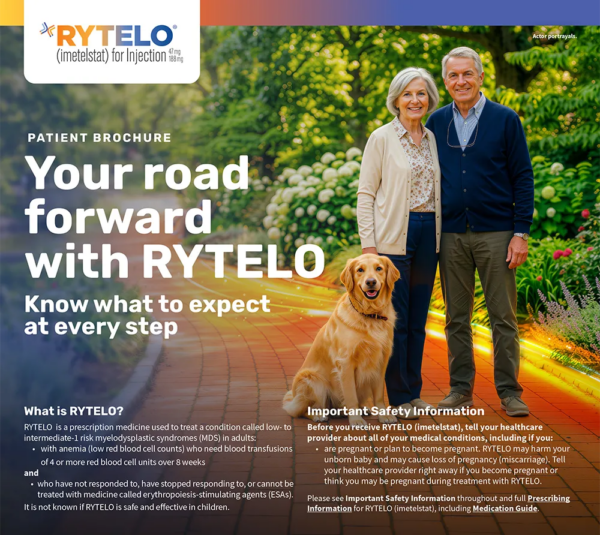
The RYTELO brochure can help you understand LR-MDS with anemia and what to expect while taking RYTELO.
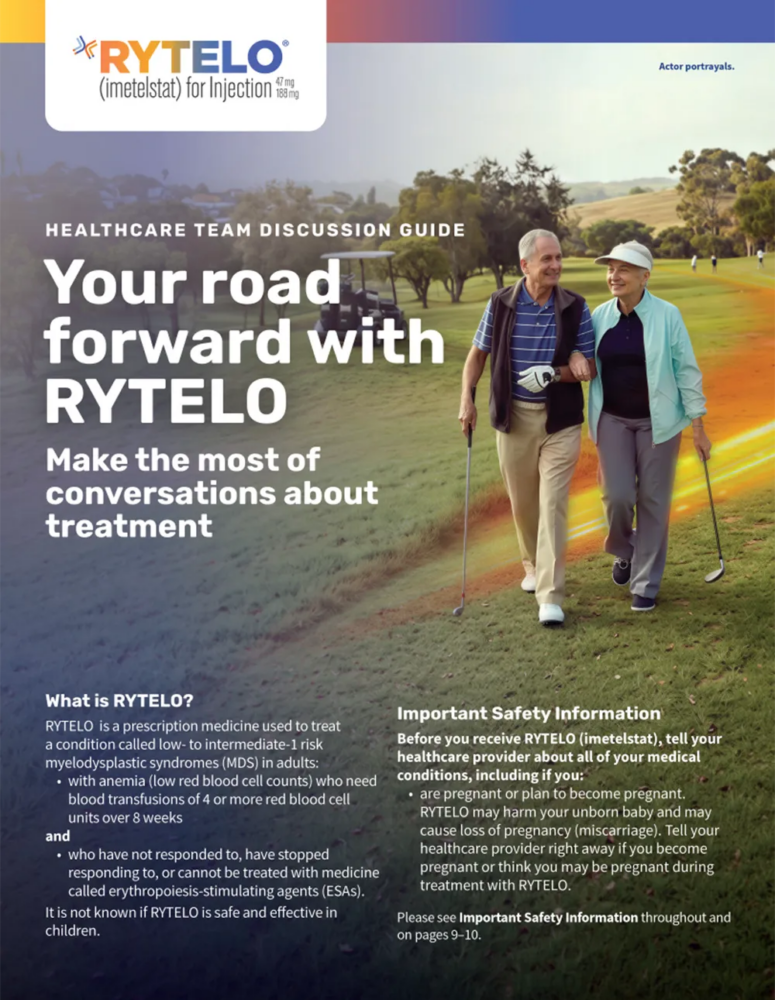
Download the care team conversation guide to help you get the most out of your discussions throughout treatment with RYTELO.

REACH4RYTELO is a patient support program that may help with insurance and out-of-pocket costs.